


A reach stacker driver at a container terminal has no desk. Neither does a picker in a warehouse, an operator on a packing line or an AB on deck. They have a phone, a break, and a supervisor who needs them back at work. Training that ignores this becomes a day in a classroom once or twice a year, and most of it is gone by the next audit.
Why short, and why on the phone
The phone is already in their pocket. DataReportal counted 127 million active mobile connections in Vietnam in early 2025, equal to 126 percent of the population.1 Not every worker has a smartphone with data to spare, and you should ask before you plan. Still, the phone is the one screen most frontline teams carry all day.
Five minutes fits the day. It fits a break, a wait at the gate or the end of a shift briefing. It also fits how people watch. In an analysis of 6.9 million video sessions on online courses, median watching time was at most about six minutes, whatever the length of the video.2
Short teaches well when it is cut well. Richard Mayer's research on multimedia learning found that people learn more deeply when a lesson comes in segments they move through at their own pace, rather than as one continuous stream, in 10 out of 10 experimental tests.3 A 2024 systematic review of 40 studies concluded that microlearning has a positive impact on learning outcomes, from knowledge acquisition and retention to engagement.4 Reviews like this mix very different settings, so read it as encouragement, not as proof that any short lesson works.
Spread out beats crammed. The forgetting curve that Hermann Ebbinghaus measured in the 1880s has been replicated in full.5 The remedies are spacing and testing. A review of 317 experiments found that spacing practice out improves long-term retention.6 In Roediger and Karpicke's study, students who practised by recalling a text remembered 56 percent of it a week later, against 42 percent for students who simply reread it.7 Short phone lessons make both easy: a lesson today, a five-question check next week.
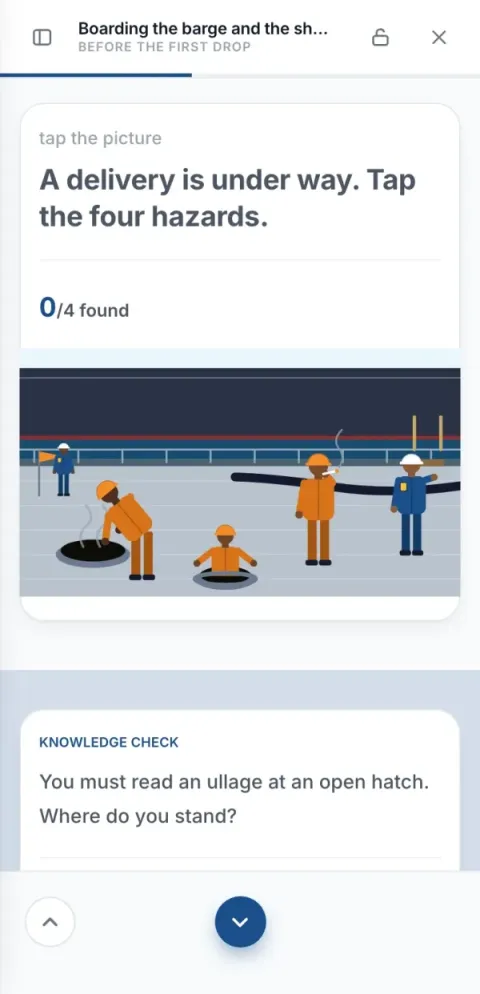
What a good frontline lesson looks like
One lesson, one job. "Reading a bill of lading" is a lesson. "Documentation" is a course. If you cannot say in one sentence what the learner will be able to do after five minutes, the lesson is too big.
Engagement on every screen. Tap the four hazards before boarding a barge. Put the six steps of a container's journey in order. Decide true or false on what a draught surveyor measures. These come from AMLA's courses, which we built, and they teach more than any paragraph of text about the same rules.
Built for the real phone. Test on the cheapest Android your people own, on weak signal, with the sound off. Big tap targets, text under every clip, nothing that needs two hands.
A rhythm, not a campaign. One launch email and a deadline give you a spike in the first week and silence after it. A short lesson each week, a reminder from the supervisor and a quick check a week later keep the rules fresh. Plan the first four weeks before you open the course, the same way you plan the shifts.
For scale: AMLA's Port of Antwerp course has 24 lessons of three to five minutes each, ends in a final check with an 80 percent pass mark, and gives a certificate valid for 24 months.
How to tell whether it works
Kirkpatrick's four levels still give the clearest frame: reaction, learning, behaviour and results.8 For a frontline programme they turn into four questions you can answer from data you mostly have already.
- Do they take it? Completion by site and by shift, and how many days after the invitation people start. A low start rate on one shift usually points to a time problem, not a motivation problem.
- Do they learn it? The first-try pass rate on the checks, and the questions most people get wrong. A question that most people fail means either the lesson does not teach it, or the question is unclear. Fix one of the two.
- Do they do it? A short observation by the supervisor two to four weeks later, on the two or three behaviours the course was made for.
- Does the number move? The figure you wrote in the brief before you started: damaged goods, documentation errors, near misses, weeks until a new hire works alone.
Keep the list that short. A dashboard with forty measures gets read once. Agree the four numbers with operations before launch and review them monthly with the site managers. Our e-book Micro-learning for frontline teams goes deeper on what to measure in the first 90 days.
Where it does not fit
A phone lesson does not replace practical training on equipment, and it should not try. It prepares people so the practical session is spent on practice, and it refreshes the rules in between. The sign-off of a hands-on skill stays with a qualified person on site. For a forklift licence, a crane operator check or a practical assessment on board, the phone lesson is the preparation and the refresher, never the test itself.
Sources
- Kepios / DataReportal (2025). Digital 2025: Vietnam. datareportal.com/reports/digital-2025-vietnam (opens in a new tab)
- Guo, P. J., Kim, J. and Rubin, R. (2014). How video production affects student engagement: an empirical study of MOOC videos. Proceedings of ACM Learning at Scale. doi.org/10.1145/2556325.2566239 (opens in a new tab)
- Mayer, R. E. and Pilegard, C. (2014). Principles for managing essential processing in multimedia learning: segmenting, pre-training, and modality principles. Cambridge Handbook of Multimedia Learning, 2nd ed., chapter 13. doi.org/10.1017/CBO9781139547369.016 (opens in a new tab)
- Monib, W. K., Qazi, A. and Apong, R. A. (2024). Microlearning beyond boundaries: a systematic review and a novel framework for improving learning outcomes. Heliyon. pmc.ncbi.nlm.nih.gov/articles/PMC11774797 (opens in a new tab)
- Murre, J. M. J. and Dros, J. (2015). Replication and analysis of Ebbinghaus’ forgetting curve. PLOS ONE 10(7), e0120644. doi.org/10.1371/journal.pone.0120644 (opens in a new tab)
- Cepeda, N. J., Pashler, H., Vul, E., Wixted, J. T. and Rohrer, D. (2006). Distributed practice in verbal recall tasks: a review and quantitative synthesis. Psychological Bulletin 132(3), 354 to 380. doi.org/10.1037/0033-2909.132.3.354 (opens in a new tab)
- Roediger, H. L. and Karpicke, J. D. (2006). Test-enhanced learning: taking memory tests improves long-term retention. Psychological Science 17(3), 249 to 255. Experiment 1. doi.org/10.1111/j.1467-9280.2006.01693.x (opens in a new tab)
- Kirkpatrick Partners. The Kirkpatrick Model. www.kirkpatrickpartners.com/the-kirkpatrick-model (opens in a new tab)


