
AI on the training team: where it speeds us up, where people decide
Our people write every script, question and translation. AI speeds up narration, subtitles, checks and packaging. Needs analysis, learning design, facts and sign-off stay with people.


AI is on our training team. It is a tool and a teammate, and we use it every day. It does not write our courses. Every script, every question, every line of feedback and every translation is written by our learning designers and native speakers, from your experts’ material. AI takes the work around the writing: narration, subtitles, checks and packaging. That is where it makes us faster. The judgment, the thinking and the decisions stay with people. Here is the split in detail, and how we check the work before your learners see it.
What our people write
Scripts and scenarios. A learning designer writes them from your procedures, your incident reports and the workshops with your experts. The scenario has to be one your people recognise from their own shift, and only someone who has listened to them can write that.
Questions and feedback. Every knowledge check question and every feedback line is written by a designer against a clear objective. A good wrong answer is a mistake people really make on the job. Your experts tell us which ones. No tool knows that.
Translations. Each language version is written by a native speaker, in the words your people actually use at work. A word-for-word translation sounds wrong to a native ear at once, and learners notice.
Where AI speeds us up
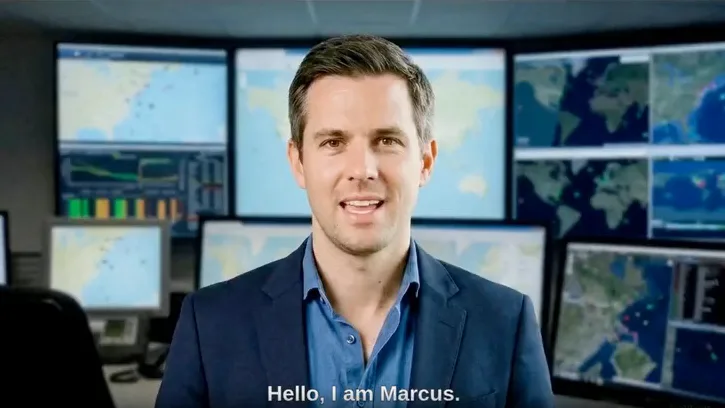
Narration in many languages. Once the script is signed off, we can narrate it in Vietnamese, English, French or Dutch without booking a studio. When a procedure changes, one sentence changes, not the whole recording. A plain voice is enough to teach. In a 2020 study, Chiou, Schroeder and Craig found that the quality of a virtual human’s voice did not significantly influence learning, although it did change how learners perceived and trusted the character.1 So we choose voices with a few learners, not for them.
Subtitles and timing. Subtitles are made from the final, signed-off script and timed to the narration. Someone then watches every video with them switched on. Timing is tedious work for a person and quick work for a tool, so that is where the tool goes.

Spelling, terminology and consistency. A course of forty short lessons in three languages is a lot of text to keep consistent. We use AI to check spelling, to flag a term used two different ways, and to check the same instruction reads the same in lesson 3 and lesson 31. It flags. A designer decides what to change.
Finding the weak spots. It points to a lesson that runs too long for a phone, a sentence that is hard to read, or a question that can be answered without doing the lesson. Often it is right. Sometimes the long lesson is long for a good reason. That call belongs to the designer.
Formatting and packaging. Laying signed-off text into screens, preparing the phone and desktop versions, and checking that every package has what your platform needs. This is repetitive work, and it is where small errors creep in when people are tired.
What stays with people
The needs analysis. What must change at work, for whom, and on which device. That comes from workshops with your experts and from looking at the job itself. Get this wrong and the best-written course still teaches the wrong thing.
The learning design. Which decisions the learner practises, which mistakes we let them make safely on screen, and how the final check proves the objective. This is where years of training adults count, and it is the part of the work we would never hand over.
Checking the facts. We never ask a tool whether a fact is right. Language models can produce text that reads fluently and is still wrong, or that strays from the source it was given. Researchers call this hallucination.2 A wrong torque value or an outdated customs rule sounds just as convincing as a correct one. A field experiment with 758 Boston Consulting Group consultants shows the trap well. On tasks that GPT-4 handled well, consultants using it completed 12.2% more tasks, 25.1% faster, at more than 40% higher quality. On a task just outside what the model could do, they were 19 percentage points less likely to reach the correct answer than colleagues working without it.3 The authors call this a jagged frontier, and you cannot always see where it runs. That is why our people write the content and a person checks every fact against your source documents.
Sign-off. Your subject expert signs off every script, word for word, before anything is built. Not us, and certainly not the tool.
How we review
Every course goes through four checks before launch:
- Expert check. Your subject expert reads the full script and signs it.
- Language check. A native speaker reads each language version as a learner would, and fixes anything that sounds translated.
- Listening check. We play every narration clip once, all the way through, with the script in front of us. Synthetic voices trip over the words your people use most: place names, product codes, acronyms, Vietnamese names inside an English sentence.
- Learner check. You tap through every screen on a phone and leave notes where something should change.
Two rules sit on top. Learner data and confidential client material stay out of AI tools. In Vietnam, the Law on Personal Data Protection (No. 91/2025/QH15) took effect on 1 January 2026 and keeps a consent-centred approach with strict formalities for consent.4 And learners are told when a voice or a course guide is synthetic. If you train people in the European Union, the AI Act asks organisations that use AI to make sure their staff have a sufficient level of AI literacy, and requires disclosure when AI-generated image, audio or video resembles real people and could pass as authentic.5 We go further than the law and say it every time. People accept a synthetic voice easily. They do not accept feeling tricked.
What it means for you
The hours AI saves on narration, subtitles and checks go back into the work that needs people: more time with your experts in the workshop, more care on every question, a closer read of every language version. When a procedure changes next year, the update is a short job, not a new project. And every word your learners read was written by someone who knows how adults learn, and signed off by your expert.
If you are planning a first course, our course storyboard template shows where each decision sits and who signs it off.
Sources
- Chiou, E. K., Schroeder, N. L. and Craig, S. D. (2020). How we trust, perceive, and learn from virtual humans: the influence of voice quality. Computers & Education 146, 103756. doi.org/10.1016/j.compedu.2019.103756 (opens in a new tab)
- Ji, Z., Lee, N., Frieske, R., Yu, T., Su, D. and others (2023). Survey of Hallucination in Natural Language Generation. ACM Computing Surveys 55(12), 1 to 38. doi.org/10.1145/3571730 (opens in a new tab)
- Dell’Acqua, F., McFowland, E., Mollick, E., Lifshitz-Assaf, H., Kellogg, K. C. and others (2023). Navigating the Jagged Technological Frontier: Field Experimental Evidence of the Effects of AI on Knowledge Worker Productivity and Quality. Harvard Business School Working Paper 24-013. ssrn.com/abstract=4573321 (opens in a new tab)
- Tilleke & Gibbins (2025). Vietnam’s New Personal Data Protection Law: A Closer Look. tilleke.com/insights/vietnams-new-personal-data-protection-law-a-closer-look (opens in a new tab)
- Regulation (EU) 2024/1689 (Artificial Intelligence Act), Article 4 and Article 50(4). Official Journal of the European Union. eur-lex.europa.eu/eli/reg/2024/1689/oj/eng (opens in a new tab)


